Tuesday, February 26, 2008
PRAYER REQUEST
Please pray for Dan and Amanda Light’s unborn baby who has a cyst on a kidney. It has not been determined how serious the problem is, and they will not know until the baby is born around April 28.


DEVOTION: Brokenness to Healing
One of our Lenten emails from the denomination (see www.ucc.org) this past week shared the following:
“Martin B. Copenhaver wrote: Ernest Hemingway sounds very much like the Apostle Paul when he writes, in A Farewell to Arms, "The world breaks everyone, and afterward some are strong in the broken places." As Christians, however, we understand our brokenness and become strong in a particular way. Paul affirms that, for the Christian, all of life is a reenactment of the death and resurrection of Jesus. His story is not just one we can hear, but a story in which we are invited to share. So the world may break everyone, but that is not the last word. The Christian holds, not that things always turn out for the best, for they seldom do, but that through it all God loves us, upholds us, receives us. That is because our God is the kind of God who insists on having the last word. To be sure, the second to last word, which may be very powerful, can be given to something else--suffering, despair, hopelessness, evil, death itself. But our God insists on having the very last word, and that is always a helpful word, a healing word, a word of peace, of hopefulness, and of life.”
In our Monday night Bible study we traveled through the history of the formation of Israel as a nation as we walked through 1st and 2nd Samuel, Kings and Chronicles. (Notes available on our church blog, fccfaithconversations.blogspot.com) We encountered what Walter Brueggemann describes as the Triad of Death; the obsession and focus on the acquisition and maintenance of Power, Wealth and Information. These three have always been the downfall of the church, because we seek them out of fear that God and the world will not sustain or protect or preserve us. The problem throughout scripture is that when we seek to acquire and keep Power, Wealth and Information we contribute to the brokenness of the world and a more subtle, yet profound, brokenness within ourselves. Because, in the end, they are an illusion; they do not provide what we think they promise. The story of ancient Israel is the story of every human, every group, every nation and every church that must experience death when they realize that this pursuit of Power, Wealth and Information does not sustain, protect or preserve us. Only faith can do that. But this death is the necessary way that leads to a resurrection of God’s Spirit within us and through us. Lent calls us to look at and see the illusion for what it is.
“Martin B. Copenhaver wrote: Ernest Hemingway sounds very much like the Apostle Paul when he writes, in A Farewell to Arms, "The world breaks everyone, and afterward some are strong in the broken places." As Christians, however, we understand our brokenness and become strong in a particular way. Paul affirms that, for the Christian, all of life is a reenactment of the death and resurrection of Jesus. His story is not just one we can hear, but a story in which we are invited to share. So the world may break everyone, but that is not the last word. The Christian holds, not that things always turn out for the best, for they seldom do, but that through it all God loves us, upholds us, receives us. That is because our God is the kind of God who insists on having the last word. To be sure, the second to last word, which may be very powerful, can be given to something else--suffering, despair, hopelessness, evil, death itself. But our God insists on having the very last word, and that is always a helpful word, a healing word, a word of peace, of hopefulness, and of life.”
In our Monday night Bible study we traveled through the history of the formation of Israel as a nation as we walked through 1st and 2nd Samuel, Kings and Chronicles. (Notes available on our church blog, fccfaithconversations.blogspot.com) We encountered what Walter Brueggemann describes as the Triad of Death; the obsession and focus on the acquisition and maintenance of Power, Wealth and Information. These three have always been the downfall of the church, because we seek them out of fear that God and the world will not sustain or protect or preserve us. The problem throughout scripture is that when we seek to acquire and keep Power, Wealth and Information we contribute to the brokenness of the world and a more subtle, yet profound, brokenness within ourselves. Because, in the end, they are an illusion; they do not provide what we think they promise. The story of ancient Israel is the story of every human, every group, every nation and every church that must experience death when they realize that this pursuit of Power, Wealth and Information does not sustain, protect or preserve us. Only faith can do that. But this death is the necessary way that leads to a resurrection of God’s Spirit within us and through us. Lent calls us to look at and see the illusion for what it is.
FAMILY DEVOTION: The Candle of Neglect
Each Sunday in the Lenten Season we are extinguishing an additional candle on our Lenten Cross. Each week the children of the church school give suggestions for the name and significance of the Candle. I ask the kids to give me descriptions of things people do that make others feel sad, frightened, hurt, angry, ashamed, worried, etc. So far the kids have we have named a candle for whining (see our Complaint Free world program), lying and this past week we named one ‘neglect’. Talk with your kids about ways that we neglect things…. Do folks neglect to do their chores, clean their rooms, do their homework, or brush their teeth? Are there classmates who are neglected by other classmates? What does it feel like when others neglect you, don’t include you in games, don’t pick you for a team, don’t invite you to a party or event? What would it feel like to be someone in a country or home where there isn’t enough food and people who could help don’t bother?
In Matthew 25 Jesus speaks about people being neglected: left without food, water, friends, clothing, medicine, visitors. He calls them the least of these. He also tells us that it is in caring for the least of these that we care for Jesus. Is there someone in your neighborhood or school who could use your help and prayers?
In Matthew 25 Jesus speaks about people being neglected: left without food, water, friends, clothing, medicine, visitors. He calls them the least of these. He also tells us that it is in caring for the least of these that we care for Jesus. Is there someone in your neighborhood or school who could use your help and prayers?
Thursday, February 21, 2008
PRAYER REQUESTS
There were no requests submitted to the church office this week for prayers from our members. However, Rev. Don would like us to pray for Bill Lawton and Joanne Cure, plus Bud Mosher and Gary Talbot.
He asked that we pray for these situations:
· The families and friends of those impacted by the Northern Illinois University shootings
· The 2008 Confirmation Class as they go on their retreat next week
· The 2008 Mission & Vision of our church
· Struggles in the Middle East and Africa
He asked that we pray for these situations:
· The families and friends of those impacted by the Northern Illinois University shootings
· The 2008 Confirmation Class as they go on their retreat next week
· The 2008 Mission & Vision of our church
· Struggles in the Middle East and Africa
Tuesday, February 19, 2008
FAMILY DEVOTION: School Vacation
School Vacation:
This is a different week with the kids home from School all day. Vacations create a nice break from the routines. They also complicate our plans when our routines change. Lent is meant to be a break from all the routines of the year, like vacation is a break from class time. Its a good chance to talk with your children about what is best about breaks...and what is the downside of a vacation time. Remind them that Lent is a time to think about our routines and change them to remind us about spending more time with God and trying to be better people. It is a good week to ask if the kids are taking part in the complaint free braclet program. (LENT = Let's End Negative Thinking) (In church on the 17th, we talked about this during the childrens message and kids had a chance to get bracelets.) (If you are not familiar with this program see our church website for a brochure fcchanoverucc.org..see LENT)
You could also ask them if they remember the names of the Candles on our Lenten Cross (Each week we extinguish one Candle that reminds of the things we do that take away light in our lives by making others feel sad, angry, ashamed, hurt, afraid...so far we have extinguished the candle of 'whining' and the candle of 'lying')
Work with your children to create a prayer that helps them remember this season's lessons.
This is a different week with the kids home from School all day. Vacations create a nice break from the routines. They also complicate our plans when our routines change. Lent is meant to be a break from all the routines of the year, like vacation is a break from class time. Its a good chance to talk with your children about what is best about breaks...and what is the downside of a vacation time. Remind them that Lent is a time to think about our routines and change them to remind us about spending more time with God and trying to be better people. It is a good week to ask if the kids are taking part in the complaint free braclet program. (LENT = Let's End Negative Thinking) (In church on the 17th, we talked about this during the childrens message and kids had a chance to get bracelets.) (If you are not familiar with this program see our church website for a brochure fcchanoverucc.org..see LENT)
You could also ask them if they remember the names of the Candles on our Lenten Cross (Each week we extinguish one Candle that reminds of the things we do that take away light in our lives by making others feel sad, angry, ashamed, hurt, afraid...so far we have extinguished the candle of 'whining' and the candle of 'lying')
Work with your children to create a prayer that helps them remember this season's lessons.
DEVOTION: The Little Ones
The Little Ones
Matthew 18: 10 - 14
Anthony B. Robinson
"Take care that you do not despise one of these little ones; for I tell you, in heaven their angels continually see the face of the Father. . ." Who are the little ones? Children? New Christians? The poor? The unsophisticated? The disabled or disfigured? The little ones have few, if any, influential friends or allies in the centers of earthly power, yet it turns out that these same little ones have influential friends, angels even, in high places not of this world, in the presence of God. The celebrated founder of the Catholic Worker movement, Dorothy Day, was speaking with a homeless man in the kitchen as the night wore on. An impatient reporter, eager to interview Day, paced outside, indicating in every way he could that he was tired of waiting and that he took precedence over Day's homeless guest. When Dorothy Day had finished her conversation with the man who was homeless, she turned to the reporter and asked, "With which of us did you wish to speak?"
Prayer: Holy One, help me to know that those who appear to have no connections, status or clout, are in truth deeply connected, connected to You. Amen.
Matthew 18: 10 - 14
Anthony B. Robinson
"Take care that you do not despise one of these little ones; for I tell you, in heaven their angels continually see the face of the Father. . ." Who are the little ones? Children? New Christians? The poor? The unsophisticated? The disabled or disfigured? The little ones have few, if any, influential friends or allies in the centers of earthly power, yet it turns out that these same little ones have influential friends, angels even, in high places not of this world, in the presence of God. The celebrated founder of the Catholic Worker movement, Dorothy Day, was speaking with a homeless man in the kitchen as the night wore on. An impatient reporter, eager to interview Day, paced outside, indicating in every way he could that he was tired of waiting and that he took precedence over Day's homeless guest. When Dorothy Day had finished her conversation with the man who was homeless, she turned to the reporter and asked, "With which of us did you wish to speak?"
Prayer: Holy One, help me to know that those who appear to have no connections, status or clout, are in truth deeply connected, connected to You. Amen.
Tuesday, February 12, 2008
DID YOU KNOW: i.ucc.org has Weekly Seeds Devotions
Here's the link to subscribe to Weekly Seeds.
Weekly Seeds is a weekly email devotional you'll receive (at no cost) every Tuesday morning. It includes a short reading from the Bible, a brief meditation, and a quote from one of our ancestors in faith. Each mailing links to an online conversation where you're welcome to share your feelings or thoughts about the Bible text for that week.
Weekly Seeds is a weekly email devotional you'll receive (at no cost) every Tuesday morning. It includes a short reading from the Bible, a brief meditation, and a quote from one of our ancestors in faith. Each mailing links to an online conversation where you're welcome to share your feelings or thoughts about the Bible text for that week.
DEVOTION: Born Again
Sunday, February 17
Second Sunday in Lent
Weekly Theme: Respect and Challenge
Prayer
God of amazing compassion, lover of our wayward race, you bring to birth a pilgrim people, and call us to be a blessing for ourselves and all the world. We pray for grace to take your generous gift and step with courage on this holy path, confident in the radiant life that is your plan for us, made known and given in Jesus Christ our Lord. Amen.
Focus Scripture
John 3:1-17
Now there was a Pharisee named Nicodemus, a leader of the Jews. He came to Jesus by night and said to him, "Rabbi, we know that you are a teacher who has come from God; for no one can do these signs that you do apart from the presence of God." Jesus answered him, "Very truly, I tell you, no one can see the kingdom of God without being born from above." Nicodemus said to him, "How can anyone be born after having grown old? Can one enter a second time into the mother's womb and be born?" Jesus answered, "Very truly, I tell you, no one can enter the kingdom of God without being born of water and Spirit. What is born of the flesh is flesh, and what is born of the Spirit is spirit. Do not be astonished that I said to you, 'You must be born from above.' The wind blows where it chooses, and you hear the sound of it, but you do not know where it comes from or where it goes. So it is with everyone who is born of the Spirit." Nicodemus said to him, "How can these things be?" Jesus answered him, "Are you a teacher of Israel, and yet you do not understand these things? "Very truly, I tell you, we speak of what we know and testify to what we have seen; yet you do not receive our testimony. If I have told you about earthly things and you do not believe, how can you believe if I tell you about heavenly things? No one has ascended into heaven except the one who descended from heaven, the Son of Man. And just as Moses lifted up the serpent in the wilderness, so must the Son of Man be lifted up, that whoever believes in him may have eternal life. "For God so loved the world that he gave his only Son, so that everyone who believes in him may not perish but may have eternal life. Indeed, God did not send the Son into the world to condemn the world, but in order that the world might be saved through him."
Reflection
by Kate Huey
At most football games, someone holds up a hand-painted sign saying, "John 3:16," the most-quoted verse in the New Testament. Unfortunately, for many, the words, "For God so loved the world...", don't describe God's deep love for the world. Instead of speaking about grace, they impose a requirement on us about being "born again," which has been interpreted as "accepting Jesus Christ as your Lord and Savior," in order to "have eternal life," or as some might say, to "be saved." But that requirement, in effect, draws a line between the "saved" and the "unsaved," right here on earth, based on what we do, as if salvation could be so simple. Isn't it just a little bit ironic that a text in which Jesus tries to get a religiously righteous person not to take things literally is often interpreted literally? And isn't it interesting that a passage about what God did and is doing (loving and saving the world) turns into something WE do?
Nicodemus seems to know that things aren't so simple. He himself appears to be coming from a place of strength: after all, he's one of "the power elite," an educated man in an age when most folks can't even read. A respected leader, he probably lives a life of comfort, at least in material terms. We're used to Jesus being approached by people in tremendous and urgent need of healing, or food, or forgiveness, and their need makes them vulnerable and open. Nicodemus, for all of his power and prestige, comes to Jesus in another kind of need: a need for answers, and for help in understanding the answers he gets. It isn't until the end of his conversation that his vulnerability shows, just a bit, perhaps, in his bewildered question, "How can these things be?" We feel the change in his tone from his first, self-confident words about what "we know." His swagger has turned into uncertainty and confusion.
Nicodemus may not know physical hunger, but his spiritual hunger drives him to Jesus in the dark of night, when many of us wrestle with questions and doubts, and face our deepest needs. Of course, it also helps that his other respected colleagues won't see him if he talks to Jesus under cover of night; they might wonder if his "faith" needs a little fine-tuning, and they might judge him for it.
None of us knows exactly how to read this text, and which tone of voice to use. Is Nicodemus argumentative or sincerely questioning? Is he in awe of Jesus and drawn to him, or just flattering him in order to find a weakness, somewhere, anywhere, in his teachings? Do the answers from Jesus anger him, or perplex him, or lead him to new life? If we check in with Nicodemus later in the Gospel of John, we find him identified by this encounter both times ("Nicodemus, who had first come to Jesus at night" 19:39). More importantly, he is changed by it: he steps in to temper the judgment of his colleagues in chapter seven, and later helps Joseph of Arimathea to bury Jesus after the crucifixion. Could the later words and actions of Nicodemus indicate a kind of conversion experience, one that leads him to greater humility and compassion, and a more open heart and mind? Or was he there, in the first place, that night, because he struggled with his own limitations and the limits of what we humans, no matter how learned or holy, can understand or accomplish, the beginning itself of a kind of "conversion experience"? Do you sense that grace was at work in bringing him to Jesus in the first place?
Speaking of being brought to Jesus: this text, again, has been interpreted at times as meaning that we must "come to Jesus," to simply accept him as our Lord and Savior, and be saved. So the question of what it means to be "saved" is an important one. Marcus Borg is especially helpful as we try to hear this text (that has, admittedly, troubled some over the years) in a new way, especially the term, "born again." In his beautiful book, The Heart of Christianity, Borg writes extensively about the "notion" of being "born again," which "is utterly central in early Christianity and the New Testament as a whole.'Dying and rising' and 'to be born again' are the same 'root image' for the process of personal transformation at the center of Christian life: to be born again involves death and resurrection. It means dying to an old way of being and being born into a new way of being...a way of being and an identity centered in the sacred, in Spirit, in Christ, in God." It makes sense, then, that "born again" can also be translated "born from above."
Borg also writes in The God We Never Knew about what it means to "believe." Rather than strict intellectual assent to propositions and claims, he speaks of belief as trust, as faithfulness, and, "in a very general sense...the belief that there's something to all of this." Borg says that faith that "believes God" is not something we can simply will, on our own: "we are led into it. It grows...It is not a requirement that we are to meet but a quality that grows as our relationship with God deepens." But we do need to "take the first step," he says, "and then another (though sometimes we are virtually pushed into this by desperation or lured into it by example or experience)." So there it is, the mystery of grace and our response, however limited, however sincere.
This way of expressing what John's Gospel is saying brings the text home, to our hearts and our experience, more effectively and more meaningfully, perhaps, than some of the more rigid interpretations we've heard. Borg titles his chapter, "Born Again: A New Heart" (in The Heart of Christianity), and who among us doesn't long at times for a new heart within us? Who among us doesn't question God in the darkest night of fear and doubt, and hope for answers and reassurance? Most of all, who among us hasn't yearned to know that "all of this" – our lives, our world, with both our struggles and our hopes – springs from love? The same verse that has been used by some to judge us is actually reassuring us about where "all of this" comes from: a God who loves the world (not the church, as one person has reminded us, but the world) so much that only God's own Beloved Son was a good enough gift for us.
Borg helps us to reclaim both the text and being "born again" by seeing spiritual growth as "a more relational and experiential understanding of faith and the Christian life." As always, he speaks of a new life marked by "freedom, joy, peace, and love," just as Paul does. This sounds like grace more than judgment and requirements do. We can't save ourselves, in fact, Fred Craddock calls this new life "a gift from above [that] is not attained by achievement, claim, or proof. Nothing could be more appropriate for Lent than a reminder that prayer and fasting do not earn anything." That doesn't mean that prayer and fasting don't serve a purpose; it's just that they don't "earn us anything."
Scott Black Johnston offers an interesting perspective on the question of how we could ever be required to make the decision to be born again: "It is ironic that many Christians treat the question, 'Are you born again?' as if it involves making a decision for God. Yet babies do not decide to be born...Instead, God is the primary player in this passage." And, he says, "The impetus behind God's desire to see us born of the Spirit is love." This text, so "bottom-line" for many, has love as its own bottom line.Nicodemus, in the reading from the Gospel of John, relies on what he has seen and heard about – the miracles of Jesus – as reason to believe. What do you rely on? In our technological world, have you ever felt that you knew too much, in a way that kept you from hearing truth with your heart instead of your brain? Have you ever felt that you were "born again"? Was this a graceful experience, or a difficult struggle – or both?For further reflectionMargaret Ebner, 14th century mystic: On Friday after St. James' Day I went into choir and began my Pater Noster. Then the greatest grace overcame me and I knew not how it would end, except that I perceived the grace was so great that I could not finish the Pater Noster. My heart was surrounded by such sweet grace and felt so light that I was no longer able to pray. I held the Name Jesus Christus within me with sweet loving power and from it I perceived wonderful, sweet fragrances rising up within me.
See The Feminine Mystic (Cleveland: Pilgrim Press) for more readings from ancient Christian tradition.
Second Sunday in Lent
Weekly Theme: Respect and Challenge
Prayer
God of amazing compassion, lover of our wayward race, you bring to birth a pilgrim people, and call us to be a blessing for ourselves and all the world. We pray for grace to take your generous gift and step with courage on this holy path, confident in the radiant life that is your plan for us, made known and given in Jesus Christ our Lord. Amen.
Focus Scripture
John 3:1-17
Now there was a Pharisee named Nicodemus, a leader of the Jews. He came to Jesus by night and said to him, "Rabbi, we know that you are a teacher who has come from God; for no one can do these signs that you do apart from the presence of God." Jesus answered him, "Very truly, I tell you, no one can see the kingdom of God without being born from above." Nicodemus said to him, "How can anyone be born after having grown old? Can one enter a second time into the mother's womb and be born?" Jesus answered, "Very truly, I tell you, no one can enter the kingdom of God without being born of water and Spirit. What is born of the flesh is flesh, and what is born of the Spirit is spirit. Do not be astonished that I said to you, 'You must be born from above.' The wind blows where it chooses, and you hear the sound of it, but you do not know where it comes from or where it goes. So it is with everyone who is born of the Spirit." Nicodemus said to him, "How can these things be?" Jesus answered him, "Are you a teacher of Israel, and yet you do not understand these things? "Very truly, I tell you, we speak of what we know and testify to what we have seen; yet you do not receive our testimony. If I have told you about earthly things and you do not believe, how can you believe if I tell you about heavenly things? No one has ascended into heaven except the one who descended from heaven, the Son of Man. And just as Moses lifted up the serpent in the wilderness, so must the Son of Man be lifted up, that whoever believes in him may have eternal life. "For God so loved the world that he gave his only Son, so that everyone who believes in him may not perish but may have eternal life. Indeed, God did not send the Son into the world to condemn the world, but in order that the world might be saved through him."
Reflection
by Kate Huey
At most football games, someone holds up a hand-painted sign saying, "John 3:16," the most-quoted verse in the New Testament. Unfortunately, for many, the words, "For God so loved the world...", don't describe God's deep love for the world. Instead of speaking about grace, they impose a requirement on us about being "born again," which has been interpreted as "accepting Jesus Christ as your Lord and Savior," in order to "have eternal life," or as some might say, to "be saved." But that requirement, in effect, draws a line between the "saved" and the "unsaved," right here on earth, based on what we do, as if salvation could be so simple. Isn't it just a little bit ironic that a text in which Jesus tries to get a religiously righteous person not to take things literally is often interpreted literally? And isn't it interesting that a passage about what God did and is doing (loving and saving the world) turns into something WE do?
Nicodemus seems to know that things aren't so simple. He himself appears to be coming from a place of strength: after all, he's one of "the power elite," an educated man in an age when most folks can't even read. A respected leader, he probably lives a life of comfort, at least in material terms. We're used to Jesus being approached by people in tremendous and urgent need of healing, or food, or forgiveness, and their need makes them vulnerable and open. Nicodemus, for all of his power and prestige, comes to Jesus in another kind of need: a need for answers, and for help in understanding the answers he gets. It isn't until the end of his conversation that his vulnerability shows, just a bit, perhaps, in his bewildered question, "How can these things be?" We feel the change in his tone from his first, self-confident words about what "we know." His swagger has turned into uncertainty and confusion.
Nicodemus may not know physical hunger, but his spiritual hunger drives him to Jesus in the dark of night, when many of us wrestle with questions and doubts, and face our deepest needs. Of course, it also helps that his other respected colleagues won't see him if he talks to Jesus under cover of night; they might wonder if his "faith" needs a little fine-tuning, and they might judge him for it.
None of us knows exactly how to read this text, and which tone of voice to use. Is Nicodemus argumentative or sincerely questioning? Is he in awe of Jesus and drawn to him, or just flattering him in order to find a weakness, somewhere, anywhere, in his teachings? Do the answers from Jesus anger him, or perplex him, or lead him to new life? If we check in with Nicodemus later in the Gospel of John, we find him identified by this encounter both times ("Nicodemus, who had first come to Jesus at night" 19:39). More importantly, he is changed by it: he steps in to temper the judgment of his colleagues in chapter seven, and later helps Joseph of Arimathea to bury Jesus after the crucifixion. Could the later words and actions of Nicodemus indicate a kind of conversion experience, one that leads him to greater humility and compassion, and a more open heart and mind? Or was he there, in the first place, that night, because he struggled with his own limitations and the limits of what we humans, no matter how learned or holy, can understand or accomplish, the beginning itself of a kind of "conversion experience"? Do you sense that grace was at work in bringing him to Jesus in the first place?
Speaking of being brought to Jesus: this text, again, has been interpreted at times as meaning that we must "come to Jesus," to simply accept him as our Lord and Savior, and be saved. So the question of what it means to be "saved" is an important one. Marcus Borg is especially helpful as we try to hear this text (that has, admittedly, troubled some over the years) in a new way, especially the term, "born again." In his beautiful book, The Heart of Christianity, Borg writes extensively about the "notion" of being "born again," which "is utterly central in early Christianity and the New Testament as a whole.'Dying and rising' and 'to be born again' are the same 'root image' for the process of personal transformation at the center of Christian life: to be born again involves death and resurrection. It means dying to an old way of being and being born into a new way of being...a way of being and an identity centered in the sacred, in Spirit, in Christ, in God." It makes sense, then, that "born again" can also be translated "born from above."
Borg also writes in The God We Never Knew about what it means to "believe." Rather than strict intellectual assent to propositions and claims, he speaks of belief as trust, as faithfulness, and, "in a very general sense...the belief that there's something to all of this." Borg says that faith that "believes God" is not something we can simply will, on our own: "we are led into it. It grows...It is not a requirement that we are to meet but a quality that grows as our relationship with God deepens." But we do need to "take the first step," he says, "and then another (though sometimes we are virtually pushed into this by desperation or lured into it by example or experience)." So there it is, the mystery of grace and our response, however limited, however sincere.
This way of expressing what John's Gospel is saying brings the text home, to our hearts and our experience, more effectively and more meaningfully, perhaps, than some of the more rigid interpretations we've heard. Borg titles his chapter, "Born Again: A New Heart" (in The Heart of Christianity), and who among us doesn't long at times for a new heart within us? Who among us doesn't question God in the darkest night of fear and doubt, and hope for answers and reassurance? Most of all, who among us hasn't yearned to know that "all of this" – our lives, our world, with both our struggles and our hopes – springs from love? The same verse that has been used by some to judge us is actually reassuring us about where "all of this" comes from: a God who loves the world (not the church, as one person has reminded us, but the world) so much that only God's own Beloved Son was a good enough gift for us.
Borg helps us to reclaim both the text and being "born again" by seeing spiritual growth as "a more relational and experiential understanding of faith and the Christian life." As always, he speaks of a new life marked by "freedom, joy, peace, and love," just as Paul does. This sounds like grace more than judgment and requirements do. We can't save ourselves, in fact, Fred Craddock calls this new life "a gift from above [that] is not attained by achievement, claim, or proof. Nothing could be more appropriate for Lent than a reminder that prayer and fasting do not earn anything." That doesn't mean that prayer and fasting don't serve a purpose; it's just that they don't "earn us anything."
Scott Black Johnston offers an interesting perspective on the question of how we could ever be required to make the decision to be born again: "It is ironic that many Christians treat the question, 'Are you born again?' as if it involves making a decision for God. Yet babies do not decide to be born...Instead, God is the primary player in this passage." And, he says, "The impetus behind God's desire to see us born of the Spirit is love." This text, so "bottom-line" for many, has love as its own bottom line.Nicodemus, in the reading from the Gospel of John, relies on what he has seen and heard about – the miracles of Jesus – as reason to believe. What do you rely on? In our technological world, have you ever felt that you knew too much, in a way that kept you from hearing truth with your heart instead of your brain? Have you ever felt that you were "born again"? Was this a graceful experience, or a difficult struggle – or both?For further reflectionMargaret Ebner, 14th century mystic: On Friday after St. James' Day I went into choir and began my Pater Noster. Then the greatest grace overcame me and I knew not how it would end, except that I perceived the grace was so great that I could not finish the Pater Noster. My heart was surrounded by such sweet grace and felt so light that I was no longer able to pray. I held the Name Jesus Christus within me with sweet loving power and from it I perceived wonderful, sweet fragrances rising up within me.
See The Feminine Mystic (Cleveland: Pilgrim Press) for more readings from ancient Christian tradition.
FAMILY DEVOTION: Noah's Ark
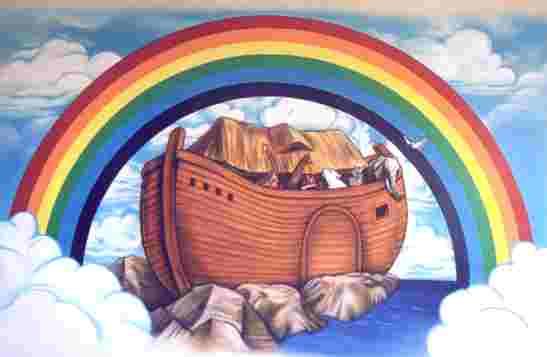 Here is a family devotion for the week:
James Evans in his book, Bringing God Home, offers the following idea. Review the story of Noah in Genesis 6:9-22. Ask the children if they know this story. Invite them to tell it or draw a picture about it. Wonder together about what it was like in the Ark with all the animals. Was it scary? What did Noah think and feel? What kinds of prayers do you think Noah said while he waited for the storm to go away? Tell about a time when things were 'stormy' in your life and you had to rely on God. Say a prayer together to thank God for helping us make it through stormy times and giving us hope to believe the storms will end.
Monday, February 11, 2008
PRAYER REQUESTS February 10-16
Bob Scott
Bill York
Jason Goloboy
Lynne White
The Wilson Family
Bill Sutcliff
Gary Talbot
Patick Macuch
Bethany
William Davison
Eric Jenkins
Family of Meg Ninos
Pattie Majenski
Ciara Leonard
Margaret Cina
Ellen Degnan
Bud Mosher
Bill York
Jason Goloboy
Lynne White
The Wilson Family
Bill Sutcliff
Gary Talbot
Patick Macuch
Bethany
William Davison
Eric Jenkins
Family of Meg Ninos
Pattie Majenski
Ciara Leonard
Margaret Cina
Ellen Degnan
Bud Mosher
Tuesday, February 5, 2008
PRAYER REQUESTS
Please keep these people in your prayers this week:
Bob Scott
Lynne White
Gary Talbot
William Davison
Pattie Majenski
Ellen Degnan
Bill Sutcliff
Jason Goloboy
Bill York
The Wilson Family
Bud Mosher
Bethany
DEVOTION
Here is a daily devotion I found online: Normally, I like to create my own to pass along, but this one could have been my own. It also provides a great link to some sound daily devotions and reflections. Check it out.
Identity Crisis
By Laura J. Bagby
CBN.com - I have to admit, I love finding out more about the personality types, but I honestly think I need to quit cold turkey.
When finding yourself in some self-analyzing test becomes an obsession, well it's time to re-prioritize. In my voracious search for self I bought every personality book I could find and I have taken every possible test. I have found out what kind of leader I am, what animal I most resemble, what color best fits my personality, and on the spiritual end, even what Bible character I am most like.
But what's next? What shape I am? What vegetable? It could conceivably continue infinitely.
What's ironic is that the search for better self-understanding only led me into confusion and depression. The results didn't match up. One survey said I was an introvert; another confirmed I was an extrovert. One swore that I was a bold leader; the other seemed to think I would rather hang back in the crowd. And on and on. I would put the book down and still wonder who I really was.
You know what I think? I think human nature is just too complex to get down on paper, and the more we try to find ourselves in some arbitrary categories, the more miserable we shall become. I can attest because eventually we always want to become what we are not.
The answer to the continual search for an identity is always Jesus Christ. What does God say about you and I? Well, He might not tell you whether you are a sanguine or an intuitive thinker or an influential leader, but what He will tell you means more than all the secular books on self-understanding.
Don't get me wrong. There is a place for such analysis. Just don't place your whole value there. God tells us that we are His children. We are co-heirs with Christ. We are in fact new creations. This is our true identity.
I like God's personality test best. All I have to do is give myself to the Lord, and He makes me more like Jesus Christ everyday. My personality quirks and foibles are now His business. He takes care of the rest.
"For you died, and your life is now hidden with Christ in God." (Col. 3:3, NIV).
FAMILY DEVOTION:
Based on “BRINING GOD HOME” by James Evans
Thank You Notes:
My mom always had to remind us to write thank you notes after birthdays and Christmas gifts had long been unwrapped and put away. Bring out some Thank You cards (or make some) to the family. Ask everyone to share a Thank You note that they remember receiving. Ask them to share what they wrote in a recent Thank You note.
Read Isaiah 35:1-10
Isaiah understands that the nation of Israel will face some difficult times when things seem bleak and lifeless like a desert. He also knows that God will create a time of joy and singing and hope. The people will have a reason to be thankful.
Invite folks to write a thank you note to God (either each person or one for the family – be creative with paint, markers, crayons…etc)
Feel free to bring the Thank You Note to Church or display it in a special place in your home.
Identity Crisis
By Laura J. Bagby
CBN.com - I have to admit, I love finding out more about the personality types, but I honestly think I need to quit cold turkey.
When finding yourself in some self-analyzing test becomes an obsession, well it's time to re-prioritize. In my voracious search for self I bought every personality book I could find and I have taken every possible test. I have found out what kind of leader I am, what animal I most resemble, what color best fits my personality, and on the spiritual end, even what Bible character I am most like.
But what's next? What shape I am? What vegetable? It could conceivably continue infinitely.
What's ironic is that the search for better self-understanding only led me into confusion and depression. The results didn't match up. One survey said I was an introvert; another confirmed I was an extrovert. One swore that I was a bold leader; the other seemed to think I would rather hang back in the crowd. And on and on. I would put the book down and still wonder who I really was.
You know what I think? I think human nature is just too complex to get down on paper, and the more we try to find ourselves in some arbitrary categories, the more miserable we shall become. I can attest because eventually we always want to become what we are not.
The answer to the continual search for an identity is always Jesus Christ. What does God say about you and I? Well, He might not tell you whether you are a sanguine or an intuitive thinker or an influential leader, but what He will tell you means more than all the secular books on self-understanding.
Don't get me wrong. There is a place for such analysis. Just don't place your whole value there. God tells us that we are His children. We are co-heirs with Christ. We are in fact new creations. This is our true identity.
I like God's personality test best. All I have to do is give myself to the Lord, and He makes me more like Jesus Christ everyday. My personality quirks and foibles are now His business. He takes care of the rest.
"For you died, and your life is now hidden with Christ in God." (Col. 3:3, NIV).
FAMILY DEVOTION:
Based on “BRINING GOD HOME” by James Evans
Thank You Notes:
My mom always had to remind us to write thank you notes after birthdays and Christmas gifts had long been unwrapped and put away. Bring out some Thank You cards (or make some) to the family. Ask everyone to share a Thank You note that they remember receiving. Ask them to share what they wrote in a recent Thank You note.
Read Isaiah 35:1-10
Isaiah understands that the nation of Israel will face some difficult times when things seem bleak and lifeless like a desert. He also knows that God will create a time of joy and singing and hope. The people will have a reason to be thankful.
Invite folks to write a thank you note to God (either each person or one for the family – be creative with paint, markers, crayons…etc)
Feel free to bring the Thank You Note to Church or display it in a special place in your home.
Subscribe to:
Posts (Atom)